
Davis County Court Records After Arrest
The arrest-to-court path in Davis County usually starts with arrest, warrant service, court commitment, or transfer to the Davis County Correctional Facility. Booking creates the jail custody record. A first appearance or initial court review follows, then the Davis County Attorney or another prosecutor reviews the law enforcement submission and files, declines, or amends formal charges. The case record opens in the court system when that charging document is entered.
The roster and the court file answer different questions. The Davis County jail inmate records page is the better source for current custody, booking time, and roster fields. The court file is the better source for the charge that was actually filed, the judge, attorney appearances, hearing history, warrants, disposition, and sentence. Booking photos are also separate from formal court records, and Davis County does not display them on the public roster.
Search Davis County Court Records
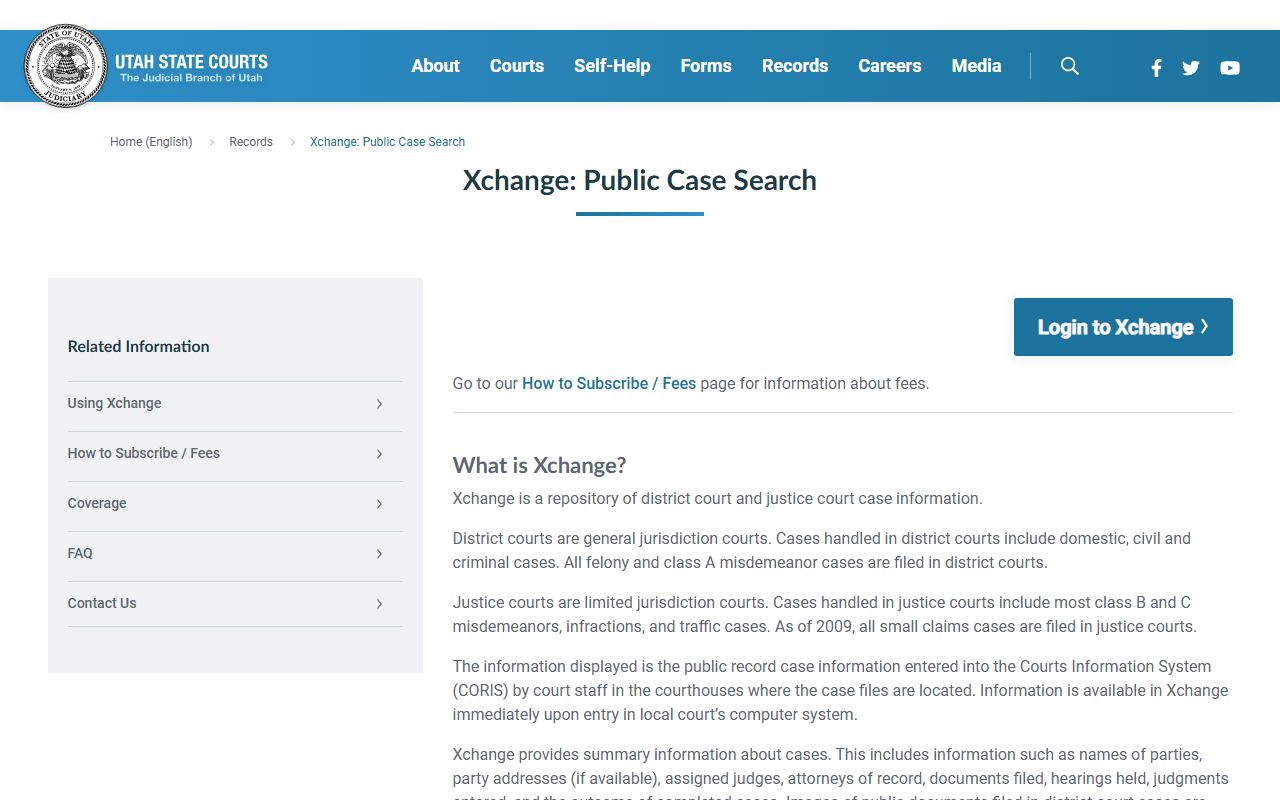
Utah Courts Xchange is the main public case-search channel for court records after a Davis County jail arrest. The Utah Courts Xchange overview says it covers district and justice court case information entered into CORIS by court staff. District courts handle felonies and class A misdemeanors. Justice courts handle many class B and C misdemeanors, infractions, traffic matters, and small claims. Davis County's Justice Court page also links the statewide warrant search and court calendar.
The Utah Xchange overview screenshot is the relevant court-record visual for a Davis County arrest because it points to filed cases, not jail booking rows.
That distinction matters when a roster charge changes or when a prosecutor files a different formal charge after booking.
- Open Utah Courts Xchange or search public case records at a courthouse using Xchange/CORIS.
- Select the court scope that fits the arrest, such as District Court, Justice Court, Davis County, or a specific Farmington court.
- Search by defendant name, case number, citation number, or date range when the available facts support it.
- Open the case number and review filing date, party information, charge entries, hearings, documents, judgments, and outcomes.
- For a user's own case, check MyCourtCase for case history, filed papers, payments, and linked cases.
Xchange is not the same as the jail roster. Utah Courts says Xchange searches are billable in the subscription system, and public district court document images may be available for purchase. Courthouse searches remain another channel for public district and justice court information.
Davis County Court Search Fields
The Xchange help material gives a more detailed field set than the Davis County jail roster. That helps when a common name appears in Davis County court records after an arrest. Case number and citation number can narrow results, but Utah Courts warns that those numbers are not unique statewide, so county, court, date, and name details still matter.
| Field | Type | Use |
|---|---|---|
| Jurisdiction | Selection | District Court, Justice Court, or both. |
| Search Type | Selection | All court cases or only judgments entered. |
| Case Number | Text | Useful when known, but not unique statewide. |
| Last name or company | Text | Main name-search field for a defendant or party. |
| First name | Text | Can narrow or expand results; Xchange help notes asterisk use for variations. |
| Case type and scope | Selection | Narrows by case type, statewide, county, or court. |
| Birth date, citation, date range | Date or text | Helps distinguish defendants and filing periods when available. |
How Charges Follow Jail Arrest
After a Davis County arrest, the booking charge may be only the first label attached to the event. The prosecutor decides what charge is filed in court. The Davis County Attorney's Office is the county prosecutor and is located in the Davis County Justice Complex. Its official contact page lists Troy Rawlings as Davis County Attorney and describes the office's criminal prosecution role. Municipal prosecutors may handle some lower-level cases, depending on the arresting agency and court.
| Document | Who Files It | What It Does |
|---|---|---|
| Complaint | Officer or prosecutor | Commonly starts many criminal cases, especially lower-level matters. |
| Information | Prosecutor | Formal charging document used in many Utah felony prosecutions. |
| Indictment | Grand jury | Formal charge returned by a grand jury in serious or selected cases. |
The court charge may differ from the jail's arrest or booking charge. Prosecutors can add, reduce, amend, or dismiss charges as evidence, legal review, plea negotiations, or court orders change the case.
Davis County Charge Status
Charge status is the snapshot of where a court charge stands. It is not the same as a criminal-history conclusion. A pending charge means the case has not been resolved. A dismissed charge is no longer being pursued in that case. A conviction requires a guilty plea, no-contest plea accepted by the court, verdict, or other adjudication that results in guilt on that charge.
| Status | Plain Meaning |
|---|---|
| Pending | The charge has been filed and is still active. |
| Amended | The prosecutor or court changed the charge from its earlier form. |
| Reduced | The charge level or offense was lowered by agreement or order. |
| Dismissed | The charge ended without a conviction on that count. |
| Conviction | The court entered guilt by plea, verdict, or other qualifying finding. |
Bond After Davis County Arrest
Davis County says bail is determined by the courts. If the court allows bail, eligible inmates may be bailed out 24 hours a day, although processing can take a few hours during busy periods. The county says bondable bail may be payable directly to the charging court, online through Team3.InmateCanteen.com with Mastercard or Visa, at lobby kiosks at the main jail or Work Release Center, or by certified check or money order through the mail. Davis County does not recommend bond companies.
| Release Term | How It Works |
|---|---|
| Cash or court-paid bail | Money paid directly when the court permits release on that amount. |
| Surety bond | A licensed bond service posts bond if the charge is bondable. |
| Personal recognizance | Release based on promise and conditions instead of upfront cash. |
| No-bond hold | The court or another authority does not permit release from that charge or hold. |
| Detainer or hold | Another agency has authority or a request that can prevent release. |
Davis County Pretrial Services adds important context. Its official page describes risk assessments, non-financial release options, court-date notification, community supervision, and the presumption of innocence. A bond amount is only one part of release after a Davis County jail arrest.
Davis County Arrest Warrants
The Davis County Justice Court page links to the Utah statewide warrant search. Utah BCI describes it as a free search of the Utah Statewide Warrants file. A warrant can lead to booking at the Davis County Correctional Facility or another jail, depending on where it is served, medical clearance, agency authority, and warrant terms. Once a person is booked locally, the county roster should be checked. If no roster match appears, court or sheriff channels may be needed.
Warrant language can be confusing. An arrest warrant orders custody. A bench warrant is often issued for failure to appear or comply. A search warrant authorizes a search, not custody by itself. A fugitive warrant or hold may come from another jurisdiction. Some warrants can be resolved through court appearance, bail, payment, or judge order. Others require booking, so legal advice should come from an attorney rather than a roster lookup.
Charges and Convictions Compared
Court records after a jail arrest often show charges before they show any outcome. A charge is an accusation filed in court. A conviction is the result of a plea, verdict, or other court finding. Davis County court records may show both, but they should not be read as the same event.
| Point | Charge | Conviction |
|---|---|---|
| Stage | Filed after arrest review | Entered after plea, verdict, or qualifying finding |
| Meaning | Alleged offense | Final guilt finding on that count |
| Can change | Yes, it may be amended, reduced, or dismissed | Yes, but only through later court action or appeal-type relief |
Sealed and Expunged Records
Utah Code Chapter 77-40a is the state's expungement and sealing framework. The details depend on charge type, disposition, waiting period, criminal history, and court order. A dismissal does not always erase every public trace by itself. A person seeking to limit public access to Davis County court records after an arrest should check the court process, not a commercial removal pitch.
| Term | Public Visibility | Key Limit |
|---|---|---|
| Sealed | Hidden from ordinary public access after a court order | Some agencies may retain limited access under law. |
| Expunged | Restricted under Utah's expungement framework | Eligibility and effect depend on the statute and order. |
| Protected record | Not available as a normal public record | Utah GRAMA decides whether a record is public, private, controlled, or protected. |
Restricted Davis County Court Records
Not every record tied to an arrest is fully public. GRAMA gives access to public records, but Utah Code 63G-2-305 lists protected categories, including law enforcement and booking-photo restrictions relevant to jail records. Juvenile records, sealed cases, protected victim information, active investigative material, and some private identifiers may be withheld or limited. Court records should be verified through Utah Courts, while jail custody should be verified through Davis County Corrections.
Important: Informal case searches are not consumer reports and cannot be used for employment, tenant screening, credit, insurance, or other FCRA-covered decisions.